Network Life World: The Leader in Network Knowledge
Network Life, part of the Network IT media company, pioneered a method of communicating with readers via the Internet. The webzine combined the best of the print world (portability, hard copy) with the best of the Web world (interactive links, electronic delivery).
This was its website,
Content is from the site's 2004 - 2005 archived pages providing a glimpse of what this site offered its readership.
Network Life Home

Welcome to Network Life
By Toni Kistner
Network World, 11/29/04
As a network expert you could never really leave work at work, but now that networks have invaded the home, you're in even greater demand. Everyone turns to you for advice about what to buy, how to set it up and, of course, how to fix it. Now you know how doctors feel.
You're not alone. In a recent survey of 1,500 Network World readers, more than 90% reported being asked for advice about home networks.
And we're here to help.
We understand the irony of your situation. You work with high-end enterprise technology all day, and when you go home your next-door neighbor, your brother-in-law and your pastor all expect you to know off the top of your head whether Linksys' new media adapter uses 802.11b or 802.11g wireless and why there's a dead spot in the kitchen.
Because Network World is the leader in network knowledge, it's natural we'd bring you Network Life: The Expert's Guide to the Connected Home.
Technology Editor Keith Shaw and I will show you the latest connected products and technologies, emerging trends and industry news, hands-on product tests - everything you need to keep up, informed and ready to meet the home network demands. We'll have some fun along the way too, bringing you tales from the field as well as fun and games for the time you'll save by reading Network Life.
The Network Life Web site will add additional content, including Buyer's Guides that link to e-commerce sites, virtual tours of high-end connected homes, a tech primer column and more.
Welcome to Network Life, a tool to help you survive the life you're living.
- Toni Kistner, Editor
Thank you Toni. This site was a life saver way back in the early 2000's. My parents have a luxury condo in Maui at a resort called The Whaler that they offer for ten months of the year as a Whaler rental in Kaanapali. It's a great way to make some money from a second home that they only utilize for two months each year. I was tasked with getting their internet up and running when they first purchased the place. Their home network demands were not that complicated, but they had no idea what to do. I offered to set everything up while also overseeing the renovation of the condo by a local contractor. I read all the advice on Network Life to become more familar with the possibilities for the "connected home." Especially enjoyed the interview with TNG/Earthling's Bob Sakayama. He's well known as someone who can drive your business via Google searches. His clients dominate their fields because of the skills he taught himself. Jump ahead to the present and where smart home technology is today. There are many smart home product categories. Today you can control everything from lights and temperature to locks and security in one's home. I have left my parents' Kaanapali condo home network to the basics, since most renters are staying only a week and don't want to read a 2" manual about how things work. My home, well that's another story for another time. Hint: I do love an automated home!
FREE Subscription Application
Network Life: The Expert's Guide to the Connected Home
If you have, plan or help others with their home networks Network Life is just what you have been waiting for. With your FREE subscription to Network life you will receive the latest information on connected products, technologies, emerging trends, industry news and results from hands-on product tests - everything you need to keep up to date, stay informed and ready to meet your home network demands.
Network Life ezine 2005
The Ultimate Storage Strategy Guide
Get tips and tricks for managing, safeguarding and enjoying the multimedia files piling up on your home network, such as:
Solve a Windows Crash in Minutes
Our primer shows how to solve problems quickly with a tool that costs nothing. With this tool, you can solve about half of Windows server and workstation crashes in a few minutes.
Content everywhere
Ways to stream your music and photos all around the house.
Bit buckets
It's not just about data any more. Home storage strategies need to take
into account everything from photos to music and movies.
Backup 101
Learn how to protect your photos, music, data and more.
Microsoft warns of file-trashing worm
By Keith Shaw
Network World, 06/06/05
When I was younger, storing a 10M-byte computer game on my father's PC drove him nuts. "Computer storage space should be saved for more valuable files," he would tell me. I can only imagine what he would think about today's storage needs on home networks, including music, digital photos, home videos and all those e-mails.
Home networks need centralized storage to save us from 16 versions of "Funkytown" spread out among six PCs. Luckily, network-attached storage devices are coming to the market that bring storage away from individual PCs to where it belongs: the network.
In addition, home users are notorious for not properly backing up their files. While in the past it might have been easier to cope with losing a file or two, in these days of 99-cent music downloads (I've spent at least $250 at iTunes in the past year), saving files becomes a serious money-saving issue.
So in this issue of Network Life, we present our Storage Strategy Guide, offering tips and suggestions on the best ways to provide your home network clients (friends, family and neighbors) the storage and back-up protection they'll need to keep them (and you) a happy network citizen.
Once you've trained your users to store their files centrally, you can get them to enjoy their multimedia content in new ways by streaming them all around the house. Our "Content Everywhere" story points out the many products on the market that aim to play music or stream video around the house.
There's lots more in this issue, as well, including a warning about home VoIP systems and our usual departments. We also would like to hear from readers about their Network Life impressions - have you been happy with what we've presented? What other topics would you like us to cover? Is this format the best way to present our advice? Send me a note at kshaw@nww.com and tell me what you like or don't like.
- Keith Shaw Editor
How to solve Windows system crashes in minutes
By Dirk A. D. Smith
Network World, 04/19/05
A system crash: If you're lucky, it only ruins your day. More than likely, you're in for several bad days followed by a few stressful weeks or months. After all, systems rarely fail only once. Rather, they keep crashing until you find the cause and fix the problem.
This primer will show you how to solve problems quickly. Using a tool that costs nothing, you can solve approximately 50% of Windows server and workstation crashes in a few minutes. The tool is WinDbg , the free Windows debugger.
You've probably never used the debugger, don't have it and don't want it. After all, it's a developer's tool, not an administrator's, right? Yes, but what you need to know is remarkably easy to learn, and even a rudimentary familiarity with the debugger could enhance your skills and your resume.
Still hesitant? Think about this: After rebooting a crashed machine, we've brought up the debugger, opened a memory dump file, given the debugger a single command, and learned not only that the cause was a driver, but also the driver's name — all in less than a minute. Granted, the debugger was installed and configured, we knew what commands to use and what to look for.
But so will you by the end of this article.
Why does Windows crash?
To date, Windows has been used most commonly on the x86 processor. The x86 implements a protection mechanism that lets multiple programs run simultaneously without stepping on each other's toes. This protection comes in four levels of privilege or access to system memory and hardware. Two of these levels are commonly referred to as kernel mode and user mode.
Kernel mode is the most privileged state of the x86. Both the Windows OS and drivers are considered trusted, and, therefore, run in kernel mode. This ensures unfettered access to system resources and the ability to maximize performance. Other software is assigned to user mode, the least-privileged state of the x86, restricting direct access to much of the system. Applications, such as Microsoft Word, run in user mode to guard against applications corrupting system-level software and each other.
Although kernel-mode software is protected from applications running in user mode, it is not protected from other kernel-mode software. For example, if a driver erroneously accesses a portion of memory that is being used by other software (or not specifically marked as accessible to drivers), Windows stops the entire system. This is called a bug check or a crash, and Windows displays the popularly known Blue Screen of Death (BSOD). About 95% of Windows system crashes are caused by buggy software (or buggy device drivers), almost all of which come from third-party vendors. The remaining 5% is due to malfunctioning hardware devices, which often prompt crashes by corrupting memory contents.
Another little-known fact is that most crashes are repeat crashes. Few administrators can resolve system crashes immediately. As a result, they typically happen again and again. It's common to see weeks and months pass before the answer is found. By solving a crash immediately after the first occurrence, you can prevent time-consuming and costly repeat crashes.
We'll focus on solving crashes under Windows 2000, XP and Server 2003. The process is identical for Windows servers and desktops. With respect to the debugging and interpretation process, this information applies with remarkably little differences to other operating systems, such as Linux, Unix and NetWare.
Getting started
To resolve system crashes using WinDbg, you need the following:
- A PC with 25M bytes of hard-disk space, a live Internet connection and Microsoft Internet Explorer 5.0 or later.
- A PC running Windows Server 2003, Windows 2000 or Windows XP.
- The latest version of WinDbg .
- A memory dump (the page file must be on C: for Windows to save the memory dump file).
The memory dump is a snapshot of what the system had in memory when it crashed. Few things are more cryptic than a dump file at first glance. Yet it is the best place to go for information on a crash. You can try to get this data in other ways - a user or administrator may remember what the system was doing when it crashed, or that they installed a new hardware device recently, in which case you can check related drivers or hardware - but they could also forget, providing incomplete or inaccurate information.
Windows Server 2003, 2000 and XP create three types of memory dump files:
Small or mini dump : A mini dump is a tiny 64K-byte file. One reason it's so small is that it doesn't contain any of the binary or executable files that are in memory at the time of a system crash. The .exes are needed for full and proper crash analysis, therefore, mini dumps are of limited value without them. However, if you are debugging on the machine that created the dump file, the debugger can find them in the System Root folders, unless they were changed by a system update (we'll provide a workaround for this later). XP and Server 2003 produce mini dumps by default, one for each crash event, as well as a full dump file. While it saves all mini dumps, the system only saves the most recent full dump. Windows 2000 can save mini dumps, but by default it is set to save only a full dump.
Kernel dump : This is equal to the amount of RAM occupied by the operating system's kernel. For an XP PC with 512M bytes of RAM, this is usually around 60M bytes, but it can vary. For most purposes, this crash dump is the most useful. It is significantly smaller than the full memory dump, but it only omits those portions of memory that are unlikely to have been involved in the crash.
Complete or full dump : This is equal to the amount of RAM in the box. Therefore, a machine with 512M bytes of RAM creates a 512M-byte dump file (plus a little). While a full dump contains all possible data and executables the memory has to offer, its sheer size can make it awkward to save or transfer to another machine for debugging. Windows 2000 produces a full dump by default.
Because XP and 2003 are set up to save a mini dump for every crash event, there should be a mini dump file for every crash the machine has had since it was turned on. This data can be extremely valuable, giving you a rich history to inspect.
Saving a memory dump
To resolve system crashes through the inspection of memory dumps, set your servers and PCs to automatically save them with these steps:
- Right-click on My Computer
- Select Properties
- Select Advanced
- In the Start up and Recovery section, select Settings; this displays the Startup and Recovery dialog box
- In the Write debugging information section, select kernel memory dump
While still in the Start up and Recovery dialog box, ensure that the following options are checked in the System failure section:
- Write an event to the system log
- Send an administrative alert
- Automatically restart
In the Write debugging information, you have the option to save only the most recent dump file or to have the system rename the existing dump file before it creates a new one. We prefer saving the dump files because previous dump files may provide additional or different information - however, space can be an issue, so set this option according to your needs.
The Write debugging information section also tells you where the dump file will be created. On XP and 2003 systems, mini dumps are located at %SystemRoot%\Minidump, or c:\Windows\Minidump; kernel and full dumps are located at %SystemRoot%\MEMORY.DMP or c:\Windows\MEMORY.DMP. For Windows 2000, memory dump files are located at c:\winnt\memory.dmp.
If you don't have a dump file on your machine, you can get one from another system or download one here. This kernel dump is about 20M bytes zipped and 60M bytes extracted. It was created using a testing tool that generates a system crash.
Content everywhere
Ways to stream media all around the house.
By Rob Garretson
Network World, 06/06/05
Sure, data backup is important. But everybody knows the killer app for network storage is home entertainment.
Microsoft's Windows XP Media Center Edition 2005 finally supports multiple TV tuners, high-definition video and DVD burning. At least 30 vendors offer digital media receivers or Media Center Extenders that stream digital content between PCs and TVs and stereos. DirecTV plans to unveil its Home Media Center this year, and Comcast recently partnered with TiVo to offer its software and service on Comcast digital video recorders (DVR).
But before you start advising friends and colleagues to turn in their old cable boxes or sell their satellite receivers on eBay, take a hard look at the cost, complexity and stability of today's home media options.
The Media Center PC is a compelling concept and in practice would make excellent use of network storage. Too bad it's not ready for prime time. Aside from the high cost - between $800 and $2,000 for a new Media Center PC, plus $200 to $500 for each extender necessary to connect a TV or stereo system - the technology is still immature. Your users won't tolerate glitches such as lag time in channel changing or an HBO movie blocked from streaming by copy protection.
If your users simply want to stream MP3 or WMA music to multiple rooms in the house, there are several digital media adapters ($150 to more than $500) that are easy to set up and work well even on older, relatively slow 802.11b networks. The $249 Roku SoundBridge M1000, Slim Devices' Squeezebox ($249 for wired, $299 for wireless), Creative's $200 Sound Blaster Wireless Music adapter and the $149 Netgear MP101 are good choices. At the high end, the Sonos Digital Music System ($1,200 for a two-room setup) is a dream come true.
Your Apple iPod fans need to know the only way to stream music purchased from Apple's popular iTunes service is to buy Apple's own digital media adapter. The $150 AirPort Express includes a wireless router (but no firewall), a USB print server and both 802.11g and wired Ethernet connections. Many media receivers will play AAC music files streamed from iTunes, but the protected AAC files bought and downloaded from iTunes will only play on the AirPort.
If you want to hear FM radio or if you have rooms not already equipped with stereo speakers, the $250 HomePod MP 100 from MacSense has built-in speakers, an FM radio tuner and Internet radio features. If radio isn't important, an inexpensive wireless boombox, such as the $130 Linksys WMLS11B , can add streaming music to any room.
Options for photo files
To stream photo files stored on a PC, consider the Linksys Wireless-B ($130) and Wireless-G ($230) Media Adapters, the Philips Streamium SL300i ($299), the Pinnacle ShowCenter ($300), Gateway's Wireless Connected ADC-320 ($200) or Prismiq's MediaPlayer ($200). These all stream JPEG files and also may support GIF, BMP, TIFF and other common photo formats. All except the Linksys Wireless-B model can also stream MPEG video files stored on a PC or NAS box, but bandwidth limitations will affect performance.
One of the best ways to stream music and share photos is with a stand-alone TiVo DVR (not the combination DirecTV satellite receiver with TiVo). The TiVo Series2 box (as low as $99) connects to the network via USB (through a wired or wireless USB adapter) and lets you stream MP3 files and photos from a PC running the TiVo Desktop software (a free download). Multiple TiVo systems can stream recorded movies and TV shows among them, although the limitations of its USB 1.1 driver makes transferring programs for viewing later more practical than streaming shows in real time.
All these applications perform well on wired Ethernet and 802.11g wireless networks. Only streaming video struggles with the lower-speed 802.11b networks, although with optimum signal strength some streaming video works fine. Unfortunately, high-definition TV is the one datastream today's home networks can't handle.
Only a handful of DVRs can record and store broadcast HD signals, and none let you stream or copy those huge files.
Garretson is a freelance writer in Gaithersburg, Md. He can be reached at rgarretson@starpower.net.
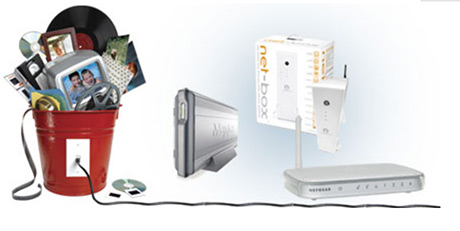
Bit buckets
It's not just about data any more. Home storage strategies need to take into account everything from photos to music and movies.
By James E. Gaskin
Network World, 06/06/05
Home network users are making the same storage mistakes business network users did in the mid-1980s. The IBM XT, with its whopping 10M-byte hard disk, let users keep their own files, defusing the push to use file servers to centralize storage. Decisions about storage locations, file organization and back-up tools - critical for the office 20 years ago - now must be made in every home with two or more PCs.
Most homes have a junk drawer (or closet) used to hide items. If your friends and family use their PCs as a junk drawer, you will get called for help far more often than you want. A messy home data storage system will cause endless frustration and money.
When the question, "How do I add more storage?" comes your way, remember (but don't admit) your early mistakes and push them toward centralized storage.
Granted, your next-door neighbor won't come and say "please help me back up more often" even though he should. But if you recommend the right storage plan, backups should be easier and performed more often.
Storage upgrade options
Replacing a hard disk with a larger one (or adding a second drive) was once the only affordable choice for home users. External hard drives connected via USB now are becoming more popular, as the USB 2.0 standard has increased throughput considerably.
External USB hard drives automatically appear as usable storage in Windows 2000 and XP systems. The drives can be moved between computers, which gives a 21st century twist on the sneakernet of old, where people carried floppies from computer to computer (and overwrote files hither and yon).
The drives can provide back-up services, and many units come with fairly sophisticated back-up software. The Iomega REV drive , an update of its old Zip drives, hold 35G bytes rather than 100M bytes and comes with real-time back-up software keyed to file changes. While counting on users to reliably use these back-up options for one PC might turn out well, normal users won't move the devices between systems enough to get good backups. Pricing for external USB hard drives has dropped to less than a $1 per gigabyte, and they are best used as a way to expand current systems.
The USB thumb drive has become the new floppy. Some devices, such as the Cruzer line from SanDisk, now include automatic folder synchronization software (PocketCache) aimed at being used for backup. Unfortunately, this only works for one PC because, like the REV drive, users probably won't remember to use the software on multiple machines. Depending on capacity, pricing ranges from $10 to $200 for a 20G-byte portable drive.
Although you understand the nature of users and don't expect much, remind your family and friends that USB drives are not a legitimate option for extra storage or regular backup, except for one computer. Even though the new Kanguru Zipper Pro USB drive ($199) holds 20G bytes in the space of six stacked credit cards, these devices aren't suitable for shared network storage because they generally get attached to one PC.
Getting NAS-ty
With more PCs attaching to the home network, network-attached storage (NAS ) devices look like a better way to pull storage out of the computer case. NAS vendors are finally helping home users organize their storage and setting the stage for a huge leap in home data management.
Parks Associates estimates about 200,000 home NAS units were sold in the U.S. last year, about 1% of the total home network market. The cost of home-appropriate NAS units has been hovering at around $2 per gigabyte, but three things will drive down that price:
- "NAS on a chip" that includes the network operating system for these types of devices.
- Buffalo's TeraStation device , which packs a terabyte of storage, brings the price down to about $1 per gigabyte.
- Mainstream acceptance of storage issues.
You might think it silly to push home users toward NAS, but these are not the same kind of NAS boxes you see in the data center. The home NAS systems are basically USB external hard drives with a minimal network operating system. Each system we've tested runs some type of embedded Linux that stays well hidden under a browser-based administration utility. This provides rudimentary file locking that works fine with standard commercial applications and provides file access (in most cases) for Macs and Linux/Unix systems through the Network File System.
So far, a lack of interest in the market hasn't slowed NAS innovation. Buffalo's TeraStation ($800, $1,000 or $2,000, depending on capacity) might be the ultimate home network bling. offers a NAS box with built-in wireless access and another model that packs a NAS into a router/firewall and wiring hub. SimpleTech's SimpleShare VHS-cassette sized, sleek, aluminum case looks at home among expensive audiophile equipment (and is silent). Linksys has two different units with removable hard disk trays for easy capacity upgrades (one tray is empty to start on the base units).
Hitachi plans to release its own half-terabyte home NAS unit this year (because Hitachi makes a considerable number of high-performance disks, this could be a screamer aimed at audio/videophiles).
All NAS units for homes and small businesses include some level of client back-up software (albeit often poor). Luckily, readily available back-up software can be used with any of the NAS units on the market.
All home NAS units rely on Microsoft client network protocols and security, leaving much to be desired for a small business user but a workable system for home users. Some experience in network design will make life easier for home NAS users.
Getting home users to buy a NAS can be tough. They'll say they can share an attached USB hard drive with other network users.
Technically true, but this relies completely on Microsoft network protocols and user-access permissions, which varies considerably depending on the reliability of the operating system version on the host computer (as well as the sophistication of the users). It also eliminates blocking the host user from any of the files stored, and Windows pass-through file performance isn't great.
f you can't convince them to go for a NAS, dedicating an older computer to become the storage server will provide many of the same features. You're still stuck with strictly Windows networking and security, but in a home setting this can be handled, especially if no one uses the computer as a PC. Configure it and then take away the keyboard and monitor. You'll have some control over which users access which folders when you enable user-level security. The important distinction is to move storage from a PC to a shared device, either a NAS unit or a "server," to make backup easier.
Organizing files
The My Documents folder has become the junk drawer for millions of PCs and billions of files. Sharing the My Documents folder between different users on one computer turns sibling rivalry into high-tech warfare. Sharing a single folder with different users across a network always leads to overwritten and accidentally deleted files, and a total lack of backup-and-restore compliance.
Most NAS devices come with a Public or Disk1 volume open to all network users. Leave that for your family or friends to play with and create three other volumes: Music, Photos and Backups.
Volumes for most home NAS devices don't have set sizes, so all the volumes will share the total disk space. Separating the volumes in this manner will ease backups,as well as force some organization on the file system.
Families that want private folders should create private volumes and assign security to those volumes. "Money" as a volume is much easier to keep private than trying to set folder-level access. Such settings work well with a real network operating system and directory service, but home NAS units fall short. So take the safe way and create private volumes.
Properly segmented, individual volumes offer more backup flexibility when you want to copy the collected files in each volume. Use the Backup volume to store each individual user's files.
Convince your family and friends to consider storage as a shared, not personal, computing resource. Today's home network shares printers, access to the Internet, and video- and audiostreams - it also can share the movies, songs and photos that your home users create.
Adding more storage to the network is like adding a shed or building a garage - but if you don't help organize the junk, you'll still be sweating when they ask for help in finding something.
Gaskin writes about technology and has been helping small and midsized businesses use technology intelligently since 1986.
In this issue
Microsoft warns of file-trashing worm
By Keith Shaw
Network World, 12/05/05
Home networks are great for sharing printers or an Internet connection, but what your users (friends, relatives and co-workers) really want to do with them is have some fun.
They¹re going to want to view digital photos on their TV, play music on their home stereo system or stream video wirelessly from one TV to another.
And they're going to ask you to set it all up for them.
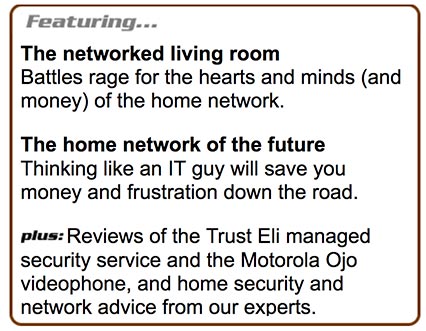
Luckily, you have your own Expert for the Connected Home to help you through any issues surrounding home networked entertainment. This issue of Network Life explores networked entertainment options, including looking at the ongoing battle for the living room and ways to avoid falling into the network home entertainment trap. James Gaskin, our Connection Coach, offers some LAN Party Planning tips (what's a LAN party? Ask your 13-year-old son) as well as other entertainment-related network questions.
Because we always want to make sure the home network is safe, we have our regular Security Chief column to inform you about the latest threats (let's just say I'm even more frightened to do anything significant on the Web), and we have a review of the new Trust Eli appliance, which wants to help keep all your systems up-to-date with the latest security features . For those who can afford it, the Motorola Ojo videophone is a nice addition to the classy, networked home .
You also may notice our new format - Network Life is pioneering a method of communicating with readers - the Webzine you are reading combines the best of the print world (portability, hard copy) with the best of the Web world (interactive links, electronic delivery).
As always, your feedback is appreciated - the e-mail box at kshaw@nww.com is always on (as long as I'm not playing a game, listening to music or streaming wireless video around the house).
- Keith Shaw, Editor
Features
The networked living room
Battles rage for the hearts and minds (and money) of home network.
Content is king
Because there is no standard DRM technology, in the near-term the only thing you can count on sharing is personal content (your own photos and home videos). Anything professionally created becomes much less portable.
The home network of the future
Thinking like an IT guy will save you money and frustration down the road.
Reviews
Why you should Trust Eli with most security updates
The Trust Eli managed service is great for those with more than one PC in the home that they want to protect.
Ojo videophone looks great, but issues remain
The Motorola Ojo videophone is like a super model: stunning but temperamental. But once the videophone wow factor cools down and you get used to the looks, will it fit comfortably into your everyday life?
Columns
LAN party planning tips and other entertaining
answers Also: How to convert albums and tapes into digital music files and getting better sound of notebook speakers.
Malware and rootkits team up for mayhem
How to defend your home net against rootkits and malware.
Retro gaming has never been better (wakka wakka wakka)
Two recent products and services are bringing back the glory days for retro gamers.
More 2005 Articles
Ojo videophone looks great, but issues remain
By James E. Gaskin
NetworkWorld.com | 12/05/05
 The Motorola Ojo videophone is like a super model: stunning but temperamental. But once the videophone wow factor cools down and you get used to the looks, will it fit comfortably into your everyday life?
Most super models don't, and the Ojo probably won't either.Consider this a second-generation videophone. It's a big improvement over Webcams with headsets, first-generation phones with half-speed, jerky video and the need to hold the phone handset to your face to talk.
The Ojo sends full-motion video at 30 frame/sec, as opposed to 15 frame/sec or slower as seen with earlier videophones. This model also has a decent speakerphone. The portrait screen orientation works great for faces, especially when compared with the landscape format on other phones.Unfortunately, this comes with a high price tag. Each Ojo device costs $800, a super-model fee in a world of subsidized cell phones and videophone hardware. Motorola also charges a monthly fee to manage the connection link database between phone users.
Installation
The User Guide and Quick Start Guide make installation look simple, and it was. Just plug the Ojo into a router and start making calls. The Ojo grabs an IP address from the router (you can assign an address if you choose). When you dial another Ojo device, the unit connects to a Motorola server that handles the Session Initiation Protocol connection, finds the target device and starts a streaming video call.
By default, recipients must press a button to activate their video camera, which prevents any awkward "jumping out of the shower" scenario for video calls. Most consumer routers allow the Ojo connect, but not all. Our Linksys WRT54GP2 device (the Vonage-enabled model for VoIP use) worked great. Two new Netgear models didn't work, nor did a Zyxel Prestige 334. The WBR-G54 wireless broadband router from Buffalo did work. Motorola says an upcoming operating system upgrade will fix most of these problems (tech support only promised soon, so it may be available as you read this).
A network administrator can open firewall ports to accommodate the Ojo protocol requirements (if these devices are used at work), but consumers won't be comfortable doing so, even if their low-end routers allow such configuration. We also were disappointed that Motorola didn't recommend any known good routers on its Web site.
Using Ojo
Once connected, Ojo does many things right. The screen's portrait mode (6- by 3.25-inches) is perfect for looking at faces. During a call, the screen shows a small image of how you look underneath the larger image of the person you're calling. This makes it simple to stay in the frame and see how you look to the other person. Controls and the phone's dial pad are on a cordless handset, which includes three custom buttons (talk, mute and end), along with a select button inside a four-way cursor ring. If you connect the Ojo to a normal telephone line, you can use the cordless handset like any cordless phone, or use the complete unit as a speakerphone.
EmergeCore combines file sharing, Web server, e-mail
By Paul Ferrill
NetworkWorld.com | 7/11/05

Small businesses looking to set up ship with e-mail, file and printer sharing, and a Web presence have options such as Microsoft's Small Business Server, or even Linux distributions that come with all the software you need (although setup and configuration isn't for the faint of heart).
For a Linux option that is simple to set up and configure, consider the EmergeCore IT-100 IT in a Box appliance. The IT-100 is a handy single-point product for file sharing, Web and FTP serving and e-mail. For most end users the cost will be part of a long-term service agreement with an ISP and shouldn't be a factor in deciding to go with the product.
Features and apps
EmergeCore's business proposition is aimed squarely at the ISP. With prices for high-speed DSL or cable continuing to drop, it's imperative for ISPs to offer some additional value to its business customers. The IT-100 offers several features that you'd normally expect to get with a higher-end server, but in a package not much larger than a small router.
The hardware portion of the IT-100 is a standard set of functions - including four 10/100 Ethernet ports, an 802.11b wireless access point, two USB 2.0 ports for attaching an external hard drive or printer, and 16G-bytes of internal user disk space. The box itself is not much bigger than a DSL modem/router combination box that many service providers are offering to customers.
The IT-100 has the basics covered with e-mail, FTP and Web servers ready to go out-of-the-box. Each component must be individually configured for use through a simple Web-based configuration screen. The system includes a Web site creation tool called Web Builder that can quickly create a basic Web site. It's comparable to similar offerings from ISP vendors such as Verizon for creating a basic home page. Web Builder offers several screens where you choose from a list of site categories or themes, add contact information and choose what type of site navigation will be displayed. Overall the process is straightforward and would work for creating a simple Web site.
Configuring client e-mail programs to use the IT-100 took only a few steps. The EmergeCore Web site offers several how-to stories, including how to configure Outlook to talk to an IT-100 mail server. It didn't offer information for other e-mail clients, although the information provided in the "Outlook How-To" was generic enough that we could configure Mozilla Thunderbird to work with it.
Sharing files on a Windows network worked like a champ. To get up and running, we just needed to enter a workgroup name and NetBIOS hostname. A drawback is the lack of support for anything other than Windows NT domains - meaning we couldn't authenticate to Active Directory or join an Active Directory domain. This would only be a problem if you have a Windows 2003 server on your network acting as a domain controller.
The system's Traveler application is included to help SMBs manage trips. It offers a place to enter an itinerary, airline, hotel and rental car information for later access. While the app is straightforward and might be useful for sharing your itinerary information with others, it wouldn't be practical unless you had constant access to the Internet.
A customer relationship management (CRM) application is also included to let SMB owners manage customer data. It's not on par with something you'd get from Siebel but it does the basics of tracking names and contact information.
Security
To protect a company's network from outside attack, the IT-100 includes a Linux-based firewall with multiple levels of protection, intrusion detection that reports on the integrity of program files, and configurable alarms. The security features are solid, based on time-tested Linux applications.
Wireless security support includes media access control address filtering (we liked how it was turned on by default), as well as username/password authentication and up to 128-bit Wired Equivalent Privacy encryption. On the downside you won't find any support for Wi-Fi Protected Access. While the box we tested did not support 802.11g, it is available as an option.
Administration
Managing the IT-100 is done through a Web browser, and can be done from anywhere with Internet access. The management console provides all the necessary information in a very readable format with a tree-view of configuration items on the left of the page, and detailed information on the right, similar to a Windows Explorer display. From the top level you see graphical and tabbed views depicting the system's status. Another nice touch is the listing of technical support phone numbers and the system's serial number on the system summary page.
A backup and restore feature lets you back up the IT-100's data locally, to an external USB storage device or over the network to a Windows file share. The automatic scheduled backup comes disabled by default, but can be easily enabled. The 20G-byte hard drive in the unit we tested was too small for more than simple e-mail storage, although you can get a 60G- or 100G-byte version.
Setup
Getting the IT-100 up and running took less than 10 minutes. An Express Setup Guide led us through the necessary steps of connecting the box to the Internet and at least one workstation. A single RJ-45 jack on the back of the IT-100 connects to either a DSL or cable modem for access to the Internet.
We disliked having to set the IP address of our workstation to 10.9.8.10 to talk to the IT-100. It would seem more intuitive to have DHCP enabled to make the setup process a little simpler. Fortunately, the configuration process prompts you for a new address if you need to change it. We liked the ability to go back and change our configuration settings at a later date. The guide says this during the first time you get to an optional component such as CRM or Traveler. All the installation dialogs are clear and easy to understand.
While the IT-100 includes both a serial and parallel port, neither one worked in our test. The EmergeCore Web site recommended using IP printing on the local network as a solution for shared printing.
Ferrill is a freelance reviewer and writer in Lancaster, Calif. He can be reached at paul.ferrill@verizon.net.

Network World
About Us
Our job is to help you be successful at yours.
With 20 years experience as the leading Network IT media company, we have what it takes to deliver the information that Network IT Executives need -- where, when and how they want it. Through our online news site, newsweekly print publication, events and executive forums and custom media solutions, Network World’s award-winning editorial delivers the up-to-date and thoughtful analysis, news, product tests, expert opinion and management strategy that our audience requires.
Connections drive success.
The network has been and continues to be the lifeblood of the enterprise. It has the power to transform businesses by changing the way a company conducts its business.
Network World targets the Network IT Executives, the experts who design, implement and manage the data, voice and video networks used by employees, customers and trading partners. They work for companies in many sectors: manufacturing, government agencies, educational institutions and financial service providers. They are the executives who set the strategic direction and technology roadmaps for their businesses.
Information. Where, When and How You Need It.
| NetworkWorld.com |
|
| Electronic Newsletters |
|
| Cutting Edge Content |
|
| Webcasts |
|
| Events & Executive Forums |
|
|
|